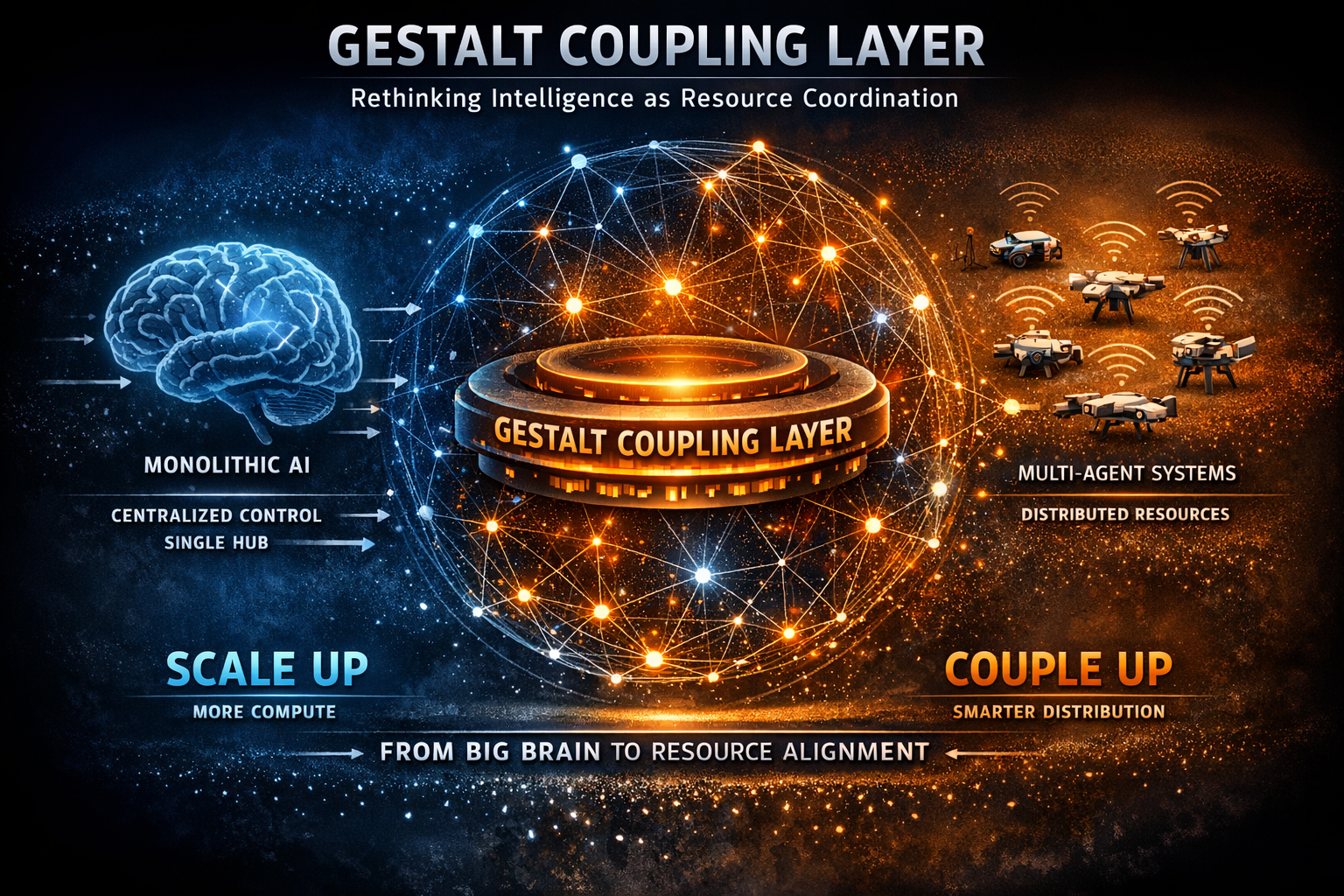
Gestalt Coupling Layer: Rethinking Intelligence as Resource Coordination
Gestalt Coupling Layer: Rethinking Intelligence as Resource Coordination
Intelligence does not scale linearly with compute. It reorganizes under constraint.
This project challenges a dominant assumption in modern AI: that progress toward intelligence is primarily a function of scale — larger models, more parameters, more data, more centralized compute.
The concept of Gestalt Coupling Layer (GCL) proposes an alternative trajectory: coordinated intelligence can emerge from many weak agents if we treat computational budget as a first-class resource and coordinate it explicitly. The technical foundation is described in the manuscript. :contentReference[oaicite:0]{index=0}
1. The Core Problem
Most Multi-Agent Reinforcement Learning (MARL) systems implicitly assume:
- stable communication
- homogeneous compute availability
- persistent coordination
- negligible computational constraints
Real-world distributed systems violate these assumptions. Industrial control, robotic swarms, and edge deployments operate under:
- heterogeneous computational budgets
- intermittent communication
- partial observability
- asynchronous updates
- resource degradation
This creates a structural mismatch between classic MARL formulations and practical distributed systems.
2. Strategic Objective
The core objective is to formalize computational budget as a controllable variable inside multi-agent decision processes.
Instead of assuming unlimited policy capacity, we model:
- per-agent compute constraints
- marginal allocation of resources
- budget-dependent policy classes
- communication-aware coordination
This leads to an extended formulation:
MR-MDP — Markov Decision Processes with Marginal Resources
The goal is not to increase intelligence by scaling models.
The goal is to produce coherent collective behavior via constrained resource redistribution.
3. From Centralized Intelligence to Coupled Rationality
Many modern AI systems rely on centralization:
- large language models
- transformer-based reasoning systems
- monolithic inference stacks
These systems:
- require massive infrastructure
- degrade under distributed deployment
- are brittle under network failures
- impose a single cognitive center
GCL rejects the “monolithic brain” assumption and instead introduces a coordination primitive:
Centerless Coordination
A system where:
- agents retain local autonomy
- no permanent dictator exists
- leadership is dynamic and budget-dependent
- global behavior emerges through coupling rather than command
This stance is conceptually aligned with the constraints highlighted by Arrow’s impossibility theorem, which implies structural limits on perfect centralized aggregation in heterogeneous multi-criteria settings.
4. What the Coupling Layer Actually Does
The Gestalt Coupling Layer does not:
- issue actions
- override local policies
- centralize memory
- aggregate preferences “perfectly”
It performs one function:
Marginal redistribution of computational budgets.
Each agent operates under a limited compute envelope. The coupling layer:
- collects minimal strategic signals
- identifies temporary coordination nodes
- redistributes computational resources
- enables fallback autonomy under failures
Unity emerges not from centralized action selection, but from resource alignment.
5. Why This Matters
This direction has practical and research implications:
5.1 Distributed Robotics
Swarms with limited onboard compute and unstable communication.
5.2 Industrial Real-Time Systems
Safety-critical platforms needing robust fallback autonomy.
5.3 Edge Intelligence
Compute-efficient architectures for constrained hardware.
5.4 AGI Research
An alternative hypothesis:
intelligence may not require scale — it may require structured coupling under constraint.
Instead of:
“more compute → more intelligence”
the project explores:
“better resource distribution → emergent intelligence”
6. Long-Term Vision
The long-term objective is to develop:
- budget-aware MARL architectures
- hierarchical marginal resource allocation (M-HRL)
- robust decentralized coordination under degraded channels
- economically sustainable AI systems
This reframes progress from capacity maximization to structural efficiency.
7. Philosophical Position (Without the Fluff)
- resource limits are not a defect; they are an organizing principle
- central authority is structurally fragile in heterogeneous systems
- robust intelligence should survive communication loss
- “super-agent” behavior can be an emergent property of coupling
If intelligence is a system-level property, its origin may lie not in magnitude, but in balance.
8. Final Reflection
Gestalt Coupling Layer is not “another model architecture”.
It is a structural proposal that formalizes:
- budget as control
- leadership as transient
- coordination as marginal
- intelligence as distributed
The hypothesis is direct:
robust intelligence in distributed systems will not be built by scaling one brain —
but by coupling many constrained ones.
Updated on 15 Feb 2025.