Dempster–Shafer Theory for Condition Diagnosis of Continuous Casting Machines
- URL pdf (RUS) VIVT Journal.
- URL to test model @Render.
This research aims to apply the Dempster–Shafer Theory (DST) to improve diagnostics of industrial equipment, focusing on continuous casting machines (CCM) in metallurgy. The main goal was to create a mathematical and software framework that aggregates uncertain, noisy sensor data — temperature, vibration, and acoustic signals — to assess equipment condition more reliably.
Key results include:
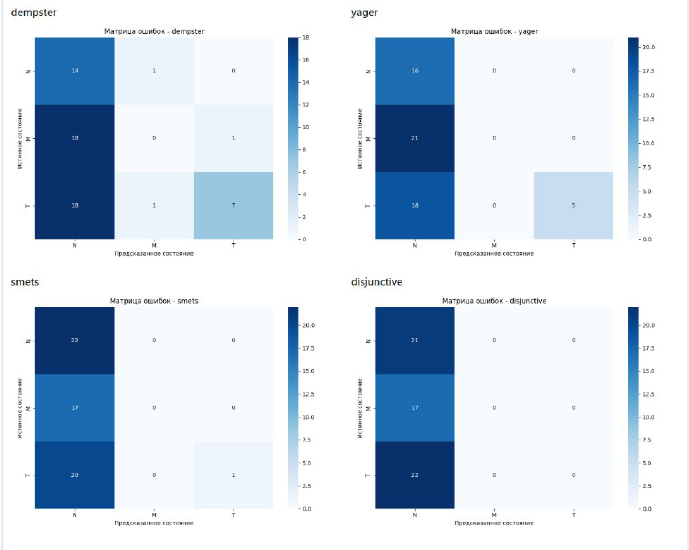
A multi-level DST-based diagnostic model for data fusion under uncertainty. Implementation of adaptive evidence combination, switching between Dempster’s and Yager’s rules depending on the conflict coefficient. Experimental validation showing a 5–6% accuracy improvement and reduced false confidence in high-conflict scenarios. A comparison with the open-source pyds library confirmed better speed and robustness of the proposed approach. The developed system provides a foundation for intelligent maintenance, IoT-based monitoring, and future multi-agent diagnostic architectures in industrial automation.
Conclusion: The research successfully demonstrates the potential of Dempster–Shafer Theory in enhancing condition diagnosis for continuous casting machines, offering a robust framework for handling uncertainty and improving diagnostic accuracy in industrial settings. Also some ideas were proposed for future research, such as integrating machine learning techniques with Dubois-Prade for predictive maintenance and exploring multi-agent systems for distributed diagnostics in complex industrial environments. Also project completed with a software implementation of the proposed DST-based diagnostic model, which is available for testing and further development. Mail me for details or if you want to collaborate on this project.
Updated on 15 Feb 2025.